What Rebels Want by Jennifer M. Hazen
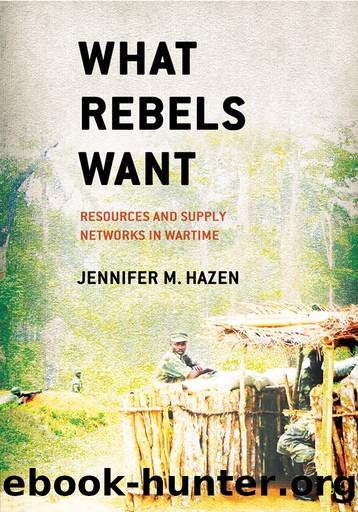
Author:Jennifer M. Hazen [Hazen, Jennifer M.]
Language: eng
Format: epub
Tags: International Relations, Africa, Arms Control, Political Science, West, History, Security (National & International)
ISBN: 9780801451669
Google: 9_2tDwAAQBAJ
Goodreads: 16234356
Publisher: Cornell University Press
Published: 2013-03-15T00:00:00+00:00
The Lomé Agreement (1999â2000)
The Lomé negotiations began in April 1999. At this time, most international observers believed that the RUF could not be defeated on the battlefield and that negotiations were the only solution.73 The United States played a prominent role in the process. At least one driving force behind U.S. interest in ending the war was the increasing pressure applied by lobbyists on the U.S. Congressional Black Caucus to intervene.74 The U.S. special envoy Jesse Jackson, who had well-known ties with the Liberian president Charles Taylor, was sent to convince Taylor to use his influence to pressure the RUF into negotiations.75 The signing of a cease-fire on 18 May 1999 opened the way for negotiations on a peace agreement.
Although the analytical framework (table 3.1) did not predict the RUF would negotiate at this time, given the strong position of the RUF vis-à -vis the government, the RUF went along with negotiations for a number of reasons. First, the RUF knew the government of Sierra Leone was negotiating from an extremely weak position. This offered the possibility of gaining large concessions through negotiations. Second, the peace negotiations offered the RUF a tremendous amount of power in a new government.76 For the RUF, there was no reason not to participate. Furthermore, participation in the negotiations, and even signing the peace deal, did not necessarily mean the RUF would willingly implement the agreement. Third, the RUF was suffering from war fatigue, having suffered punishing attacks by the Guinean army in June, although this fact emerged only after negotiations. Evidence of the need for respite came days after the signing of the peace agreement as thousands of rebels and civilians emerged from the RUF areas in search of food. Furthermore, splits in the RUF leadership in late 1999 suggested that the RUF needed time to restore order to its house before proceeding with the war effort.77 Finally, under international pressure from the United States and Liberia, as well as Libya and Burkina Faso (key elements in the support chain to Liberia, which in turn fed the RUF war machine), the RUF agreed to the stipulations of the Lomé agreement.78
Lomé, no matter how apparently beneficial to the RUF, never had the opportunity or the political support to succeed. The failure of Lomé cannot be blamed on the RUF alone. There is ample evidence that the government of Sierra Leone was also slow to implement the peace agreement and remained unwilling to share power with the rebels.79 The desire to negotiate with the rebels came from the international community, not the government of Sierra Leone. Both Sankoh and the government of Sierra Leone were insincere in their willingness to negotiate and sign the agreement because neither side was truly committed to implementing the peace agreement.80 Several cabinet members in the government of Sierra Leone threatened revolt in June if President Ahmed Tejan Kabbah signed the Lomé agreement. Reports of intense diplomatic pressure by the U.S. government suggest one reason why the government ultimately relented and signed the Lomé Accord in July 1999.
Download
This site does not store any files on its server. We only index and link to content provided by other sites. Please contact the content providers to delete copyright contents if any and email us, we'll remove relevant links or contents immediately.
| Arms Control | Diplomacy |
| Security | Trades & Tariffs |
| Treaties | African |
| Asian | Australian & Oceanian |
| Canadian | Caribbean & Latin American |
| European | Middle Eastern |
| Russian & Former Soviet Union |
The Secret History by Donna Tartt(19088)
The Social Justice Warrior Handbook by Lisa De Pasquale(12190)
Thirteen Reasons Why by Jay Asher(8910)
This Is How You Lose Her by Junot Diaz(6887)
Weapons of Math Destruction by Cathy O'Neil(6280)
Zero to One by Peter Thiel(5802)
Beartown by Fredrik Backman(5754)
The Myth of the Strong Leader by Archie Brown(5507)
The Fire Next Time by James Baldwin(5446)
How Democracies Die by Steven Levitsky & Daniel Ziblatt(5219)
Promise Me, Dad by Joe Biden(5153)
Stone's Rules by Roger Stone(5088)
A Higher Loyalty: Truth, Lies, and Leadership by James Comey(4964)
100 Deadly Skills by Clint Emerson(4925)
Rise and Kill First by Ronen Bergman(4789)
Secrecy World by Jake Bernstein(4753)
The David Icke Guide to the Global Conspiracy (and how to end it) by David Icke(4720)
The Farm by Tom Rob Smith(4512)
The Doomsday Machine by Daniel Ellsberg(4490)
